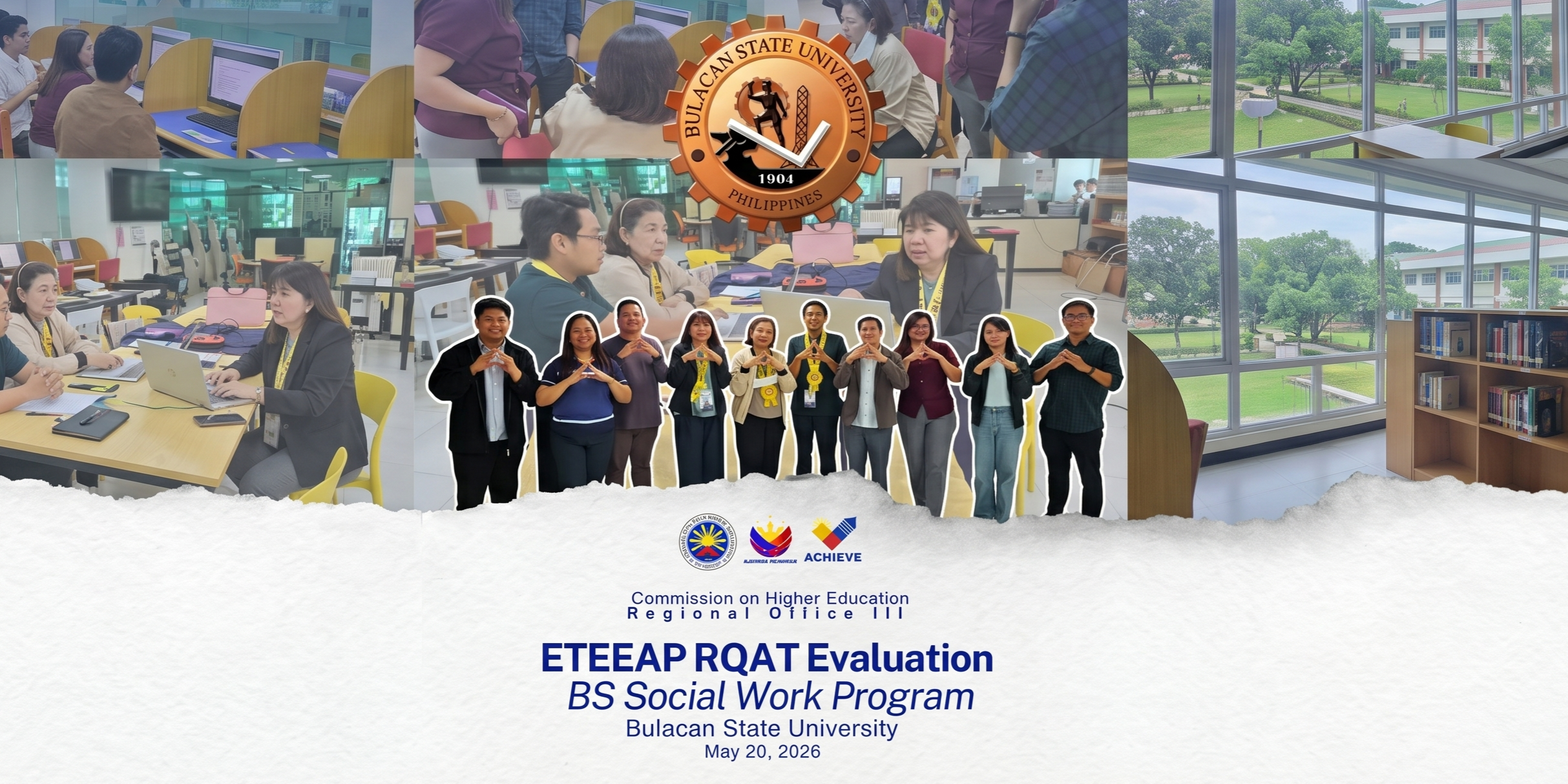
CHED Region 3 Evaluates Bulacan State University's BS Social Work Program Under ETEEAP
On May 20, 2026, the Commission on Higher Education (CHED) Regional Office III deployed its Regional Quality Assessment Team (RQAT) to conduct a formal evaluation of Bulacan State University’s (BulSU) Bachelor of Science in Social Work program under the Expanded Tertiary Education Equivalency and Accreditation Program (ETEEAP). The visit is part of CHED’s active efforts to expand the network of quality-assured ETEEAP providers across the country, ensuring that working professionals in Central Luzon have access to credible and academically rigorous pathways to a college degree.
For the thousands of social workers and community development practitioners in the region who have spent years building their careers without a formal diploma, this development is worth paying close attention to.
In This Article
- What Is an RQAT Evaluation?
- Why Bulacan State University and BS Social Work?
- The ACHIEVE Agenda: The Policy Behind the Visit
- What ETEEAP Deputization Means for Applicants
- What Comes Next for BulSU and Region 3
- Who Can Apply for ETEEAP?
What Is an RQAT Evaluation?
Before any higher education institution can offer degree programs under the ETEEAP, it must go through a structured deputization process overseen by CHED. The RQAT, or Regional Quality Assessment Team, is the body that conducts on-site evaluation visits to determine whether a school is genuinely ready to implement the program.
Under the Implementing Rules and Regulations (IRR) of Republic Act No. 12124, which institutionalized ETEEAP as a permanent part of the Philippine educational system, the RQAT works alongside CHED Regional Offices and Technical Panel Evaluators to assess several critical areas:
Institutional readiness. The visiting team examines whether the school has a dedicated office or unit with trained personnel to manage the day-to-day operations of the ETEEAP, from receiving applications to conducting assessments and awarding degrees.
Assessment infrastructure. The IRR requires deputized schools to maintain a well-documented system of assessment tools and methodologies, including written examinations, portfolio evaluations, practical demonstrations, and oral panel interviews. The RQAT verifies whether these tools are in place and aligned with competency standards.
Compliance with program policies. Schools must have a Manual of Operations that defines their ETEEAP processes and demonstrates alignment with the Policies, Standards, and Guidelines (PSGs) set by CHED for the specific degree program being offered.
Support services and learning modalities. HEIs are expected to offer flexible learning pathways to accommodate working adults, including access to technology, library resources, and other facilities that make the competency enrichment phase manageable for applicants who cannot attend traditional classes.
The RQAT evaluation is not a formality. It is the primary quality gate that ensures only institutions genuinely capable of delivering a rigorous and credible program are authorized to award ETEEAP degrees. Applications that are found fully compliant by the CHEDRO are then endorsed to the Office of Programs and Standards Development (OPSD) for final review, after which the Commission en Banc makes the final decision on deputization.
Why Bulacan State University and BS Social Work?
Bulacan State University is a public state university serving one of the most populous provinces in Central Luzon. Its location places it within reach of a large number of working adults who have spent years in fields related to community service, social development, government welfare programs, and non-governmental organizations.
Social work, as a discipline, is deeply connected to practical experience. Many individuals currently working in community development offices, local government units, and welfare agencies have built substantial expertise over the years without holding a formal degree in social work. For these professionals, the ETEEAP offers a way to have that expertise formally recognized and to obtain the academic credential that may be required for career advancement or professional licensure.
Under RA 12124, one of the key responsibilities of CHED is to work with agencies like the Department of Education, TESDA, and the Department of Labor and Employment to identify priority programs that are most in-demand or needed in each region. Social work is precisely the kind of discipline that responds to community needs, which aligns directly with the program’s founding policy.
The RQAT visit to BulSU signals that the university is pursuing authorization to serve this underserved group of professionals through the ETEEAP framework.
The ACHIEVE Agenda: The Policy Behind the Visit
The May 20 evaluation at Bulacan State University is directly connected to CHED’s ACHIEVE Agenda, the commission’s strategic framework for advancing Philippine higher education. One of the central pillars of this agenda is the promotion of advanced and accessible lifelong learning, and the ETEEAP is one of the flagship programs driving that commitment.
CHED Regional Office III has been notably active in pushing ETEEAP awareness and access across Central Luzon. In recent months, the regional office has carried out public outreach through broadcast media to reach working professionals who may not yet know the program exists. The RQAT evaluation at BulSU is a continuation of that same momentum, moving from awareness-building toward actually expanding the number of authorized institutions in the region.
This institutional expansion matters. Currently, only a small number of HEIs across the Philippines hold active CHED deputization to offer ETEEAP programs. The addition of new providers, especially public state universities in regions with large working populations, directly increases the program’s reach and makes it more accessible to people who cannot travel far or afford the fees of private institutions.
You can read more about CHED Region 3’s recent outreach efforts and how they are framing the ETEEAP for Central Luzon residents in this earlier article: Tuning In to a New Future: CHED Region 3 Promotes ETEEAP on RWFM 95.1 and CLTV 36.
What ETEEAP Deputization Means for Applicants
If BulSU successfully completes the deputization process, professionals in Bulacan and surrounding areas in Central Luzon would have a nearby public state university authorized to assess and award a BS Social Work degree through ETEEAP. That is a significant development for several reasons.
Affordability. State universities and colleges generally offer lower tuition and assessment fees compared to private institutions. For working professionals supporting families, cost is often the deciding factor in whether they pursue a degree at all.
Proximity and familiarity. Having an authorized institution within the region removes the logistical burden of traveling to Metro Manila or other distant areas to complete assessments or enrichment coursework.
Regional relevance. A university deeply embedded in its local community is well-positioned to recruit and field industry-relevant external assessors from the social work sector in Bulacan and Central Luzon. These are the practitioners who will evaluate whether an applicant’s years of community service work genuinely translate into the competencies required for a BS Social Work degree.
Once an institution becomes deputized, it is authorized to convene a Panel of Assessors composed of internal faculty and external industry professionals. This panel reviews each applicant’s prior learning through a combination of portfolio evaluation, written and practical examinations, and an oral defense. After determining which academic credits can be awarded based on demonstrated competencies, the school identifies any remaining gaps and prescribes competency enrichment coursework to bridge them. The candidate graduates once all requirements are fully met.
For an overview of the full application and assessment process, visit eteeap.ph/pages/eteeap.html. You can also browse the current list of active ETEEAP providers at eteeap.ph/pages/schools.html.
What Comes Next for Bulacan State University and Region 3
The RQAT evaluation on May 20 is not the final step. After the visit, the CHEDRO will prepare its assessment and, if BulSU is found fully compliant, will endorse the application to the OPSD at the national level for final review. The Commission en Banc then makes the official decision on whether to grant deputization.
If approved, BulSU’s authority as an ETEEAP provider would be valid for five years, with interim monitoring to ensure the program continues to meet standards. The school would then be included in the official directory of accredited ETEEAP schools, making it discoverable to professionals actively looking for a provider.
The ongoing expansion of ETEEAP’s network of providers reflects the commitment embedded in RA 12124: that flexible, competency-based pathways to a college degree should be available in every region of the Philippines, not just in urban centers. The BulSU evaluation is one more step in that direction.
For the latest updates on newly approved ETEEAP providers, including the recent recognition of Romblon State University as a new ETEEAP provider, read: Romblon State University to Be Formalized as ETEEAP Provider at the 32nd CHED Anniversary.
Who Can Apply for ETEEAP?
For social workers, barangay-level development officers, NGO workers, and local government welfare staff who are following this development, it helps to know whether you would be eligible to apply once BulSU becomes authorized. The minimum qualifications under RA 12124 are clear:
- Filipino citizenship, whether residing in the Philippines or abroad.
- At least 23 years of age at the time of application, supported by a PSA-authenticated birth certificate.
- Completion of secondary education, as evidenced by a high school diploma, a PEPT placement qualifying you for college, or an ALS Accreditation and Equivalency certification.
- A minimum of five cumulative years of work experience in an industry directly related to the degree program being sought. For BS Social Work, this means documented work in roles involving community organizing, social welfare, case management, livelihood programs, or similar functions.
- Demonstrated proficiency in the discipline, through certifications issued by employers, government regulatory bodies, or licensed practitioners in the field.
Individual deputized schools may add their own admission requirements on top of these national minimums, so it is always best to confirm directly with the institution once they receive their authority.
Not sure if you qualify? Use the eligibility checker at eteeap.ph/pages/eligibility.html to get a clearer picture before you reach out to any school. For a full breakdown of the documents you will typically need to prepare, browse the Get Started guide.
The RQAT evaluation at Bulacan State University on May 20, 2026 is a quiet but meaningful signal that ETEEAP continues to grow toward the people who need it most. For working professionals in Central Luzon who have spent years serving their communities without a diploma to show for it, the possibility of a nearby, affordable state university offering a BS Social Work degree through ETEEAP could be the turning point they have been waiting for.
Stay informed. Check back at eteeap.ph for updates on BulSU’s deputization status and other newly authorized ETEEAP providers across the Philippines.